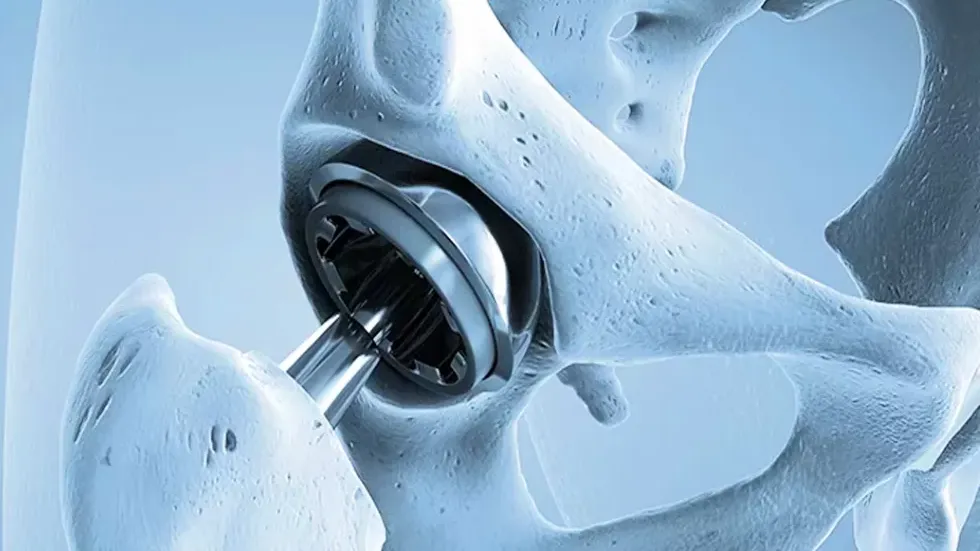
In cases of advanced wear of the hip joint (hip osteoarthritis), joint-preserving therapy can no longer provide lasting relief from symptoms. Depending on the individual’s suffering, we consider the implantation of an artificial joint (hip prosthesis).
Your orthopedist in Berlin places particular emphasis on individual planning tailored to the specific needs of the patient. Personal factors such as age, athletic demands, and pain intensity are the focus of treatment.
Whenever possible, all hip prostheses are operated on using a muscle-sparing, minimally invasive approach. In most cases, the operated leg can be fully weight-bearing immediately after the operation. Walking should be possible again on the first day after surgery. Discharge from inpatient treatment is often possible after just four days. The minimum goal is to restore mobility. Sports with an endoprosthesis are also usually possible again due to the muscle-sparing approach.
Minimally Invasive Hip Arthroplasty
Low-complication surgical technique Fast recovery through muscle protection Smaller, cosmetic skin incisions Best functional result
The artificial hip joint (hip endoprosthesis, THA) is now a routine procedure in orthopedic clinics. A high level of patient satisfaction can be achieved even with the classic operation method using larger standard accesses to the hip joint.
A further development of the classic surgical technique is the minimally invasive approach. This can achieve even higher patient satisfaction and a better functional result after the operation.
The decision as to which therapy is the most suitable for you individually will be made after detailed advice from us in the consultation.
Advantages of the minimally invasive surgical technique:
Rapid Mobilization
The muscle-sparing operation allows very rapid mobilization – minimally invasive hip endoprostheses in Berlin can usually be weight-bearing immediately. The first attempts to walk are usually made together with the surgeon just a few minutes after the procedure.
Fewer Complications
After the implantation of an artificial hip joint, complications such as thrombosis, pneumonia, or embolisms can occur in rare cases. These are often the result of the usual initial bed rest or immobility. With early mobilization, the risk of such problems occurring after immobilization is significantly reduced. The smaller incision and the soft tissue-friendly approach result in less bleeding and rapid wound healing.
Useful for Every Patient Age
For young patients, a muscle-sparing approach is recommended due to the even greater sporting demands. As you get older, the amount of muscle in your body decreases. Therefore, it makes sense to avoid any muscle damage, especially in older patients.
Increased Satisfaction with the New Joint!
Quick mobilization means less psychological stress after the procedure. It increases confidence in the new joint. The psychological component is also a factor that should not be underestimated when it comes to satisfaction with the artificial joint.
Modern, Proven Implants
It is important that modern implants allow gentle implantation and ensure a long service life. Only proven implants from well-known manufacturers are used. The highest quality of the implants used is continuously monitored using data from national and international endoprosthesis registers.
Discharge
Discharge in our department is based on fixed criteria, such as safe independent climbing of stairs. Even with minimally invasive procedures, the hospital stay does not have to be shortened. Discharge takes place exclusively in consultation with the patient. However, compared to the standard procedure, patients feel comfortable again more quickly and therefore often want to go home after just a few nights.
Sports with the New Joint
The minimally invasive, muscle-sparing procedure is particularly suitable for sporting demands. The muscle-sparing approach ensures a high level of stability. Most sports can also be performed again with the artificial joint. Your sports orthopedist in Berlin will be happy to offer you individual medical advice.
Surgical Technique
The surgical technique is much gentler on the muscles and soft tissue compared to the classic implantation technique. The aim is to completely protect the muscles surrounding the hip joint. This ensures immediate resilience of the new joint. We usually use a modern anterior approach to the hip joint (AMIS technique). This is particularly gentle on the muscles.
Follow-up Treatment
The prosthesis can be fully weight-bearing immediately, so that the first steps on the new hip can be taken directly after the operation. Follow-up treatment (“rehab”) is initiated according to your wishes and can be inpatient or outpatient.
If you have questions about hip replacement in Berlin, please call us at 0151 25394870. We look forward to helping you.
Dr. Alexander Moser
Your hip specialist in Berlin
”Hip surgery at the highest level”
Hip replacement Berlin – Minimally invasive hip arthroplasty – Muscle-sparing hip surgery – AMIS technique Berlin
Watch the explainer video
Frequently asked questions
When is the right time for a hip replacement?
<p>The decision for a hip replacement is made individually and depends on various factors:</p><p>– <strong>Pain intensity:</strong> When pain in daily life and at night is no longer controllable and significantly impairs quality of life.</p><p>– <strong>Functional limitation:</strong> With increasing limitation of movement and walking disability.</p><p>– <strong>Failure of conservative therapies:</strong> When physiotherapy, medication, and injections no longer provide sufficient relief.</p><p>– <strong>Advanced wear:</strong> When joint-preserving therapy (<a href="/en/joint-preserving-hip-surgery-hip-arthroscopy">hip arthroscopy</a>) can no longer provide lasting relief.</p><p>Your orthopedist in Berlin will discuss the optimal time for the procedure with you, depending on your personal suffering, age, athletic demands, and pain intensity.</p>
What is the advantage of minimally invasive, muscle-sparing hip replacement?
<p>Minimally invasive hip replacement offers numerous advantages over the classic surgical technique:</p><p>– <strong>Muscle-sparing approach:</strong> The surrounding muscles are preserved and not cut (especially with the AMIS technique).</p><p>– <strong>Faster mobilization:</strong> In most cases, the operated leg can be fully weight-bearing immediately.</p><p>– <strong>Shorter hospital stay:</strong> Discharge is often possible after just 3-4 days.</p><p>– <strong>Less blood loss:</strong> The soft tissue-sparing approach results in less bleeding.</p><p>– <strong>Faster wound healing:</strong> Smaller, cosmetically more favorable skin incisions.</p><p>– <strong>Less pain:</strong> Reduced postoperative pain due to muscle preservation.</p><p>– <strong>Better function:</strong> Higher patient satisfaction and better functional outcome.</p><p>– <strong>Lower complication risk:</strong> Fewer thromboses, pneumonias, and embolisms due to early mobilization.</p>
How long does a hip replacement last?
<p>Modern hip replacements have very good long-term durability. Longevity depends on various factors:</p><p>– Modern prostheses made of high-quality materials (ceramic, highly cross-linked polyethylene) achieve lifespans of 20-25 years and more.</p><p>– The survival rate after 15-20 years is over 90-95%.</p><p>– Durability is continuously monitored through data from national and international arthroplasty registries.</p><p>– Only proven implants from renowned manufacturers are used.</p><p>– Longevity can be positively influenced by an adapted activity level and avoidance of high-risk sports.</p>
Can I do sports with a hip replacement?
<p>Yes, sports with a hip replacement are usually possible again in most cases. The minimally invasive, muscle-sparing surgical technique is particularly suitable for athletic demands:</p><p>– The muscle-sparing approach ensures high stability of the new joint.</p><p>– Recommended sports include swimming, cycling, walking, golf, and dancing.</p><p>– Sports with higher impact such as jogging, tennis, or skiing are often possible after appropriate practice and consultation.</p><p>– Sports with a high risk of falling and impact loading should be avoided.</p><p>Your sports orthopedist in Berlin will be happy to advise you individually on your sports activities.</p>
How does rehabilitation proceed after a hip replacement?
<p>Rehabilitation after a hip replacement is an important part of treatment success:</p><p>– <strong>Immediately postoperative:</strong> The first steps are taken on the first day after surgery. The prosthesis can be fully weight-bearing immediately.</p><p>– <strong>Inpatient stay:</strong> 3-5 days, with daily physiotherapy and gait training.</p><p>– <strong>Follow-up rehabilitation ("Rehab"):</strong> Initiated according to your wishes and can be inpatient or outpatient.</p><p>– <strong>Discharge criteria:</strong> Safe, independent stair climbing, stable walking ability with aids, pain-reduced mobilization.</p><p>– <strong>Long-term follow-up:</strong> Regular check-ups to monitor prosthesis fit and function.</p>
What surgical approaches are there for hip replacement?
<p>There are different approaches for implanting a hip prosthesis:</p><p>– <strong>Classic approach (transgluteal):</strong> Larger skin incision, cutting of muscles and tendons, longer recovery time.</p><p>– <strong>Minimally invasive anterior approach (AMIS technique):</strong> Our preferred approach. The hip prosthesis is implanted through a small incision on the front of the hip. Muscles are preserved and not cut. This allows immediate weight-bearing and faster mobilization.</p><p>– <strong>Posterior approach:</strong> Approach from the back, also muscle-sparing possible, but higher dislocation risk.</p><p>– <strong>Lateral approach:</strong> Approach from the side, also with different muscle sleeves.</p><p>The choice of approach is individually adapted to the patient's anatomy and needs.</p>
What types of prostheses are available?
<p>Various types of prostheses are available for hip replacement:</p><p>– <strong>Standard total hip arthroplasty:</strong> Replacement of the femoral head and acetabulum with a stem anchored in the femur.</p><p>– <strong>Short-stem prosthesis:</strong> Shorter stem that is even more bone-preserving and particularly suitable for younger patients.</p><p>– <strong>Hip resurfacing (cap prosthesis):</strong> Only the worn cartilage is replaced, the head is preserved.</p><p>– <strong>Cementless fixation:</strong> The prosthesis is press-fitted, bone grows into the rough surface.</p><p>– <strong>Cemented fixation:</strong> The prosthesis is fixed with bone cement, mainly in older patients with poor bone quality.</p><p>– <strong>Bearing surfaces:</strong> Ceramic-on-ceramic, ceramic-on-polyethylene, or metal-on-polyethylene – depending on activity level and patient age.</p>
What are the risks of hip replacement surgery?
<p>As with any surgical procedure, hip replacement carries potential risks:</p><p>– General surgical risks (thrombosis, embolism, infection, wound healing disorders)</p><p>– Specific risks such as dislocation, leg length discrepancy, loosening of the prosthesis, fractures, nerve or vascular injuries</p><p>– The minimally invasive technique reduces many of these risks through the muscle-sparing approach and early mobilization</p><p>– Careful planning and precise surgical technique minimize the risk of complications</p><p>– Regular follow-up examinations help to detect and treat problems early</p>
When can I return to work after hip replacement?
<p>Return to work depends on the nature of your occupation:</p><p>– <strong>Office work/Sedentary occupations:</strong> After about 2-4 weeks</p><p>– <strong>Light physical work:</strong> After about 6-8 weeks</p><p>– <strong>Moderate physical work:</strong> After about 8-12 weeks</p><p>– <strong>Heavy physical work:</strong> After about 12-16 weeks, possibly with restrictions</p><p>The individual return to work should always be done in consultation with your surgeon and occupational health physician.</p>